

“It’s the tribe’s now.”
Temple Smith had tears in his eyes as he uttered those words to me on a cold January day. It was understandable. Letting go is hard. But letting go is the only way for a new adventure to begin. And what a ride this has been.
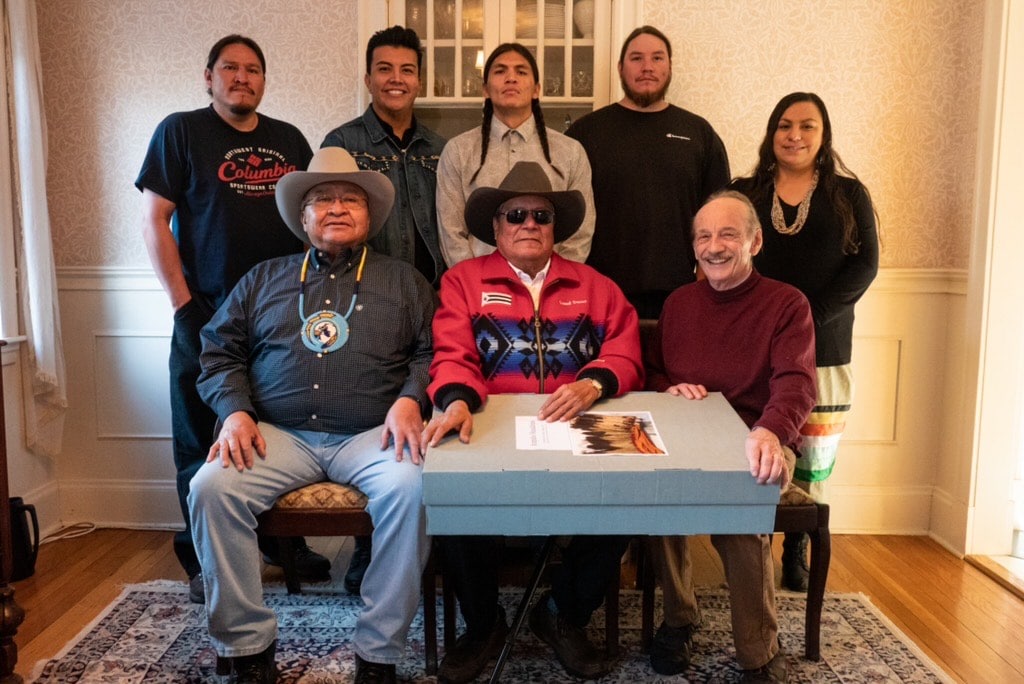
In early December, I received a phone call from Sherry Blackburn, director of the Black Coal Senior Center in Arapaho. A man named Temple Smith had contacted her and said he had an item he wanted to return to the tribe. As the collections manager for the Northern Arapaho Tribal Historic Preservation Office, I often get messages regarding donations. I asked what item he had. “Chief Black Coal’s headdress,” she replied.
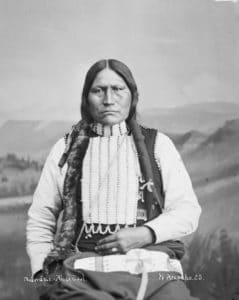
A chill ran down my spine. Chief Black Coal was a revered leader who helped the Arapaho people transition to reservation life. He championed higher education and encouraged his people to learn as much knowledge as they could to survive and prosper during this new era. He served alongside other notable Arapaho chiefs such as Sharp Nose, Friday, Yellowcalf, Lonebear and Goesinlodge.
Immediately, our office sprang into action. I have a master’s degree in museum studies, so I knew the steps we needed to take.
I contacted Smith to inquire about the headdress. Most specifically, how did he acquire it? During the late 1800s, Smith’s great grandpa worked as a dentist out of Buffalo, Wyoming. He would travel to the Wind River area and provide dental services to the tribal people including Black Coal. As a gift, Black Coal gave him his headdress, and it was passed down within his family.
Eventually, Smith became the headdress’s owner. He took great care of it, keeping it in a custom-made box that he would rarely open, for fear that it might get damaged.
But deep down, Smith said, he knew it was time for the headdress to return to its people. He knew it was time to let go.
So in early January, a small delegation traveled to Massachusetts to bring the headdress home. Smith graciously allowed us into his home, and explained how much this moment meant to him. Emotions were high when the lid of the box was removed and the headdress was finally revealed. It was like seeing an old man. It was like meeting Chief Black Coal.
Over the years, I have traveled to various museums to view collections of tribal artifacts. It can be an intense experience.
I have been taught by tribal elders to take great care in touching the items since they hold power. Each item is alive so you have to do things in an attentive way. You have to have a good heart. Seeing the items is like meeting an old friend. It brings you happiness.
That feeling is quickly replaced with sadness when you have to put those old friends back on their storage shelves. You have to leave them behind.
In 1990, the Native American Graves Protection Repatriation Act was passed into law. It provided tribes a process to retrieve items that were housed in institutions that receive federal funds. Those items include human remains, funerary objects, sacred objects and items of cultural patrimony. But NAGPRA has its limitations: It does not apply to private collectors or tribes that are not federally recognized.
Black Coal’s headdress did not fall under NAGPRA since it was privately held. It came down to a moral issue. Smith and his family believed the headdress belonged back with its people. They did the right thing — which in the museum world is a rare thing.
In 2016, I appeared in a documentary called, “What Was Ours.” It raised the question of who owns the cultural material of tribes from across the nation. The film highlights my journey of bringing back Arapaho artifacts that are owned by the Episcopal Church out of Casper.
We couldn’t utilize NAGPRA since the church doesn’t receive federal funds. We had to negotiate. The process was long and frustrating, but ultimately rewarding since we were able to secure a loan that allowed us to display a small portion of the collection at the Northern Arapaho Experience Cultural Room at the Wind River Hotel and Casino in Riverton.
People often ask me if we are able to bring back more items from that collection. The answer is no. Under the original loan conditions, the items would be switched out every year enabling us to rotate new items through the display. The collection has not been changed since 2014, however, despite repeated attempts to contact the church. Basically, the collection has been abandoned.
In the film, we also traveled to the Chicago Field Museum, which houses a vast collection of plains indian items. You could spend months opening each storage shelves and gazing at the items that our ancestors made with love, respect and purpose.
Support Wyoming storytelling with a tax-deductible donation.
My favorite pieces are the quill work made from dyed porcupine quills. Only certain societies could practice this art. Today, you don’t see much quill work being made by people from Wind River. I looked at each piece as a learning tool that we could use to revive this practice so it doesn’t get lost.
But the Field Museum hasn’t been open to the idea of repatriations, despite receiving federal funds and thus being subject to NAGPRA. In 2018, my office traveled to Chicago to consult about four Arapaho skulls in their collection. We believe in reburying human remains to complete their life cycles, not sitting on shelves. In the end, the Field Museum said it believed the skulls were not Arapaho. The battle goes on. We continue to fight.
The process is not always so difficult. Our office has completed successful repatriations with the Smithsonian, Yale University and the University of Wyoming. Other institutions, such as the Museum of Boulder and the Fort Collins Museum of Discovery, have gone above and beyond to consult with us regarding their cultural exhibits.
In the end, it’s about communicating and ensuring that our voices are heard. It’s about doing the right thing.
As we loaded the headdress into our vehicle and started the long drive back to Wind River, I started to think about the headdress and the new world it was entering. For over 100 years it lived tucked away in a box hundred of miles away from his people. Once again, you have to remember that these items are living. That headdress is alive. It’s Chief Black Coal, and he was finally coming home.
At the Northern Arapaho Tribal Historic Preservation Office, we believe this is the cornerstone on which to build our own museum — a site where we can house the items we bring back.
Our goal isn’t to clean out every museum of its Arapaho items. It’s still important for those institutions to use our items to tell vital stories about tribal people. We want to work with them and build a relationship that will benefit everyone.
But it all starts with letting go. Just like Temple Smith did. And for his example, I am grateful.

We believe the artifacts belong to the Arapaho and Shoshone tribes. It makes us sad to know they sit on those shelves in Chicago; there is so much for us to learn from these artifacts. Can we ‘average citizens’ do something to help with this? We admire Jordan Dresser and his work, too!
Thank you, Mr. Dresser, for this essay. I admire your work.