


Years ago, after lugging a heavy backpack about a dozen miles over Ishawooa Pass in northwest Wyoming, I dropped into a place called the Thorofare.
Encompassing portions of Yellowstone National Park and surrounding wilderness, it’s often considered the most remote spot in the Lower 48. Contained inside is the suite of wild creatures that existed before European settlers: grizzly bears, mountain lions, wolves, eagles, elk, martens, mule deer and marmots, to name a few.
Rains and thunderstorms ushered my companion and me into the Thorofare that night. When we woke in the morning, we saw traces of what we missed while we slept: grizzly prints traipsing down the muddy trail.
And now I know why.
New research out of the Washington State University Bear Research, Education and Conservation Center shows that grizzly bears prefer, when possible, the path of least resistance. In fact, their bodies are designed to use energy at different rates than the big game they sometimes catch and kill. The same can be said of human bodies, which is why bears often use trails built for people.
“A lot of what I’ve done in the past is educating people on how to live responsibly in bear country, and that is something that some people take for granted, that if they are on the trail they feel fairly safe,” said Tony Carnahan, PhD student at the University of Washington and the project’s lead researcher.
“The fact that bears like to use the same gradients means you should always act responsibly,” Carnahan said.
Carnahan used bears and specialized research equipment — including, yes, treadmills — at the Conservation Center to understand their energy expenditure. He combined the research with GPS locations from wild, collared bears in the Greater Yellowstone Ecosystem. The results shed new light on why humans run into grizzlies on trails, how bears move and why.
“This is a perfect example of laboratory work that is translated directly to the long-term data we’ve been collecting here in Yellowstone and providing us with some really good insights,” said Frank Van Manen, Interagency Grizzly Bear Study Team leader. “It’s exciting to connect the experimental work with real data on the ground and have solid ecological interpretations.”
Treadmills and apples
Before diving into why it matters how much energy bears use while moving, it’s important to lay out how Carnahan gathered his results. It was a bit more complicated than, say, strapping on a FitBit or heart-rate monitor.
Fortunately for researchers — though unfortunately for anyone recreating in bear country — grizzlies are highly food motivated.

The Bear Research, Education and Conservation Center has 11 captive bears, including four from the Yellowstone area that had become conditioned to humans. Researchers work regularly with the bears, which helps the creatures understand that playing along equals rewards.
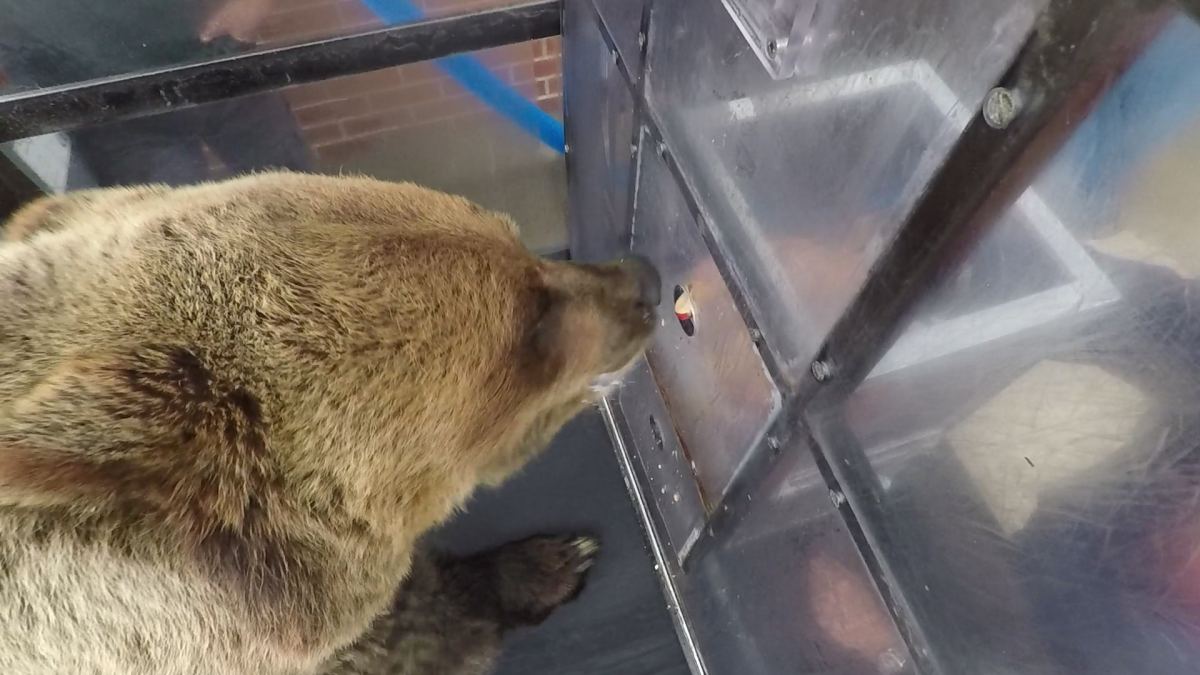
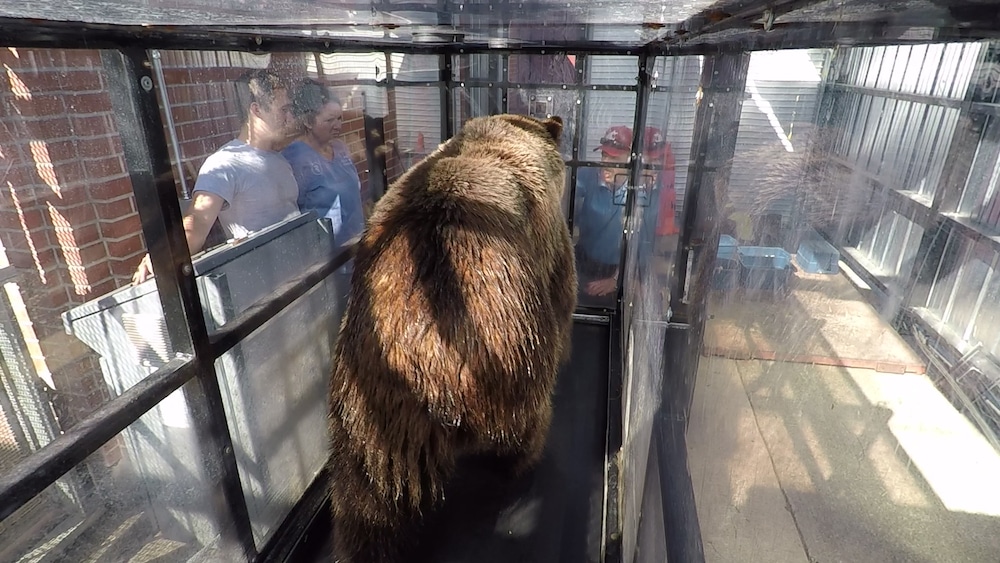
Carnahan ushered the bears into an enclosed treadmill and fed them apple slices through a hole in front to keep them walking on the moving pathway.
“The biggest problem most of them had was when we very slowly started turning the treadmill on, they were moving away from the food. That was a little hard for some of them to comprehend, and so they would do some kind of little crawl movement to try and get back up to where the food was being given,” Carnahan said. “Eventually they figured out if they walked they would stay even with the food.”
A machine then drew air out of the chamber to sample oxygen levels. The results showed how hard the bears were working.
“There are techniques in our field that we can use using GPS technology, and we can say things like ‘they move faster around roads,’ or ‘they might make more direct movements,’” Carnahan said. “But there was never a way to put an actual price to it, a cost. In this case, that cost is in kilocalories or calories.”
Support independent reporting — donate to WyoFile today
Carnahan and his team found that bears used a significant amount of energy going uphill, and rarely engaged in long, high-speed pursuits. They used similar amounts of energy to humans, wolves and wild cats, and about 46% less energy than elk and deer over mountainous terrain.
That makes sense, because grizzly bears eat almost anything, and are rarely in a hurry to get anywhere. Their main goal is to fatten up for hibernation.
“They are trying to limit their energy expenditures and maximize their intake,” said Dan Bjornlie, large carnivore biologist with the Wyoming Game and Fish Department.
The path easiest traveled
Armed with data to understand why bears are less likely to charge up a hill over rough terrain, Carnahan partnered with researchers including Van Manen to compare the information to GPS points in the wild.
What the team found surprised even Van Manen, a longtime grizzly bear researcher. The optimal pace for bears to move and also conserve calories, according to Carnahan’s research, is 2.7 miles per hour. Bears in the wild, however, move on average at about 1.4 miles per hour.
Why the pace differs is the next question.
Using trails isn’t just easier when grazing on moths, blueberries, pine nuts, grass, fish or any of the other hundreds of foods grizzlies eat, Bjornlie said. It’s also an advantage when bears aim to cover long distances – trying to return home after being relocated for getting too close to humans for example. In those instances too, they use trails.
For humans, this information reinforces why we should make noise while hiking on trails in bear country. It also underscores why increasing numbers of fast, quiet mountain bikes and e-bikes are concerning.
Deep in the Thorofare that day, I sang whatever songs I could remember as we trudged down the muddy path. The footprints faded as the day progressed and the trail dried. Eventually we ran into a sow and cubs. They heard us from across a creek and ran the other way.
“Most bears, if they hear a person is coming, will move off the trail and out of sight,” Carnahan said. “Chances are, a bear will be on the trail.”
Thanks Christine. Kind of neat to put some numbers to the travel times/speed of bears. I get more concerned about noisy trails along pocket water streams or windy forested trails. I’m not fast enough to surprise one any more but runners and bikers need to be really noisy and hyper vigilant.