

A shortage of viral transport medium has slowed COVID-19 testing in Wyoming and nationwide. Now, at least one Wyoming doctor is working around the bottleneck by using a simpler, more common, CDC-backed, substitute: medical saline solution.
Dr. Brent Blue of Emerg+A+Care in Jackson is sending patients’ samples to a laboratory “with a simple swab in a saline solution,” he wrote WyoFile. Until recently, public health agencies have recommended that samples be sent in a liquid viral transport medium that’s more complex to make than medical saline solutions.
Officials point to a dearth of vials holding the sophisticated viral transport material as a chokepoint inhibiting widespread testing. Dr. Paul Ebert, chief medical officer of Wind River Family and Community Health Center in Arapaho, talked about it in a video released last week.
“There’s a very limited amount of that media available right now,” he said.
Blue’s private testing services provider LabCorp OK’d the saline medium, starting early this week. The World Health Organization backed the simpler process on March 19. The federal Centers for Disease Control on Wednesday posted a guideline allowing the use of saline solution for transporting samples. Also on Wednesday, state health officials said Wyoming is “looking at” alternatives like saline solutions that could help unlock its testing bottlenecks.
Aside from the medium, testing requires a Dacron swab, Blue said, and a sterile vial, both relatively common health-care products. The swab is similar to but longer than a Q-tip, he said.
To collect a sample, a health-care worker inserts the swab deep into a patient’s nose. Once removed, “you just break the swab off,” to make it shorter, and place it in a sterile vial, he said.
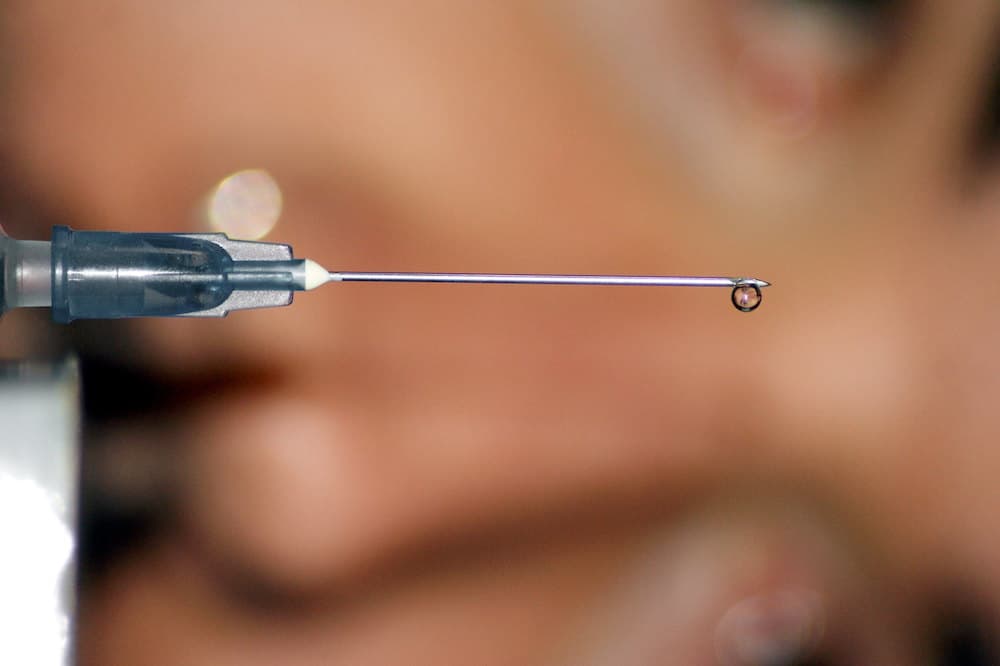
Blue uses a needle to draw the sterile saline out of a common IV bag, he said, and add it to the vial. Saline solution is sodium chloride diluted to 0.9% in water — the same concentration of salt as in human blood, he said.
“We certified with LabCorp it was OK to send the specimen in with saline,” Blue said. LabCorp is the corporate laboratory services giant that he uses to analyze patient samples for COVID-19.
Because of test rationing, “we have sick patients who are told [by others] they’re not sick enough,” for a test, Blue said. He is offering to test any patient who wants to be tested for an $80 fee.
“It’s obviously not the ideal method,” he said of the testing and shipping procedure, “but it’s the method you can use.” The WHO wrote that the samples in saline solution may not be viable for the same amount of time as those in the conventional media. Blue sent samples to LabCorp early this week but had not received results by mid-week, he said.
Researchers proved the concept in 2011
A team at the Victorian Infectious Diseases Reference Laboratory in Melbourne, Australia identified the need for alternative testing materials during the 2009 influenza A H1N1 pandemic.
“Virological swabs and transport medium became in short supply, and alternatives were often used,” they wrote in the Journal of Clinical Microbiology in 2012. But, “systematic data regarding [the alternatives’] suitability were lacking,” the article reads.
In their experiments, Dr. Julian Druce and four colleagues compared more common swabs and transport media to the specialized testing and shipping tools and materials that make up harder-to-come-by testing “kits.” They compared swabs collected and transported dry or in saline to commercially available swab/medium combinations.
The results showed that the simpler testing and transporting method was a valid alternative during times of pandemics. “Our observation that collection and transport of influenza virus on dry swabs in saline is appropriate for [polymerase chain reaction] detection is important for future pandemic planning,” the article reads.
While the Australian research focused on influenza, Blue said if a transport medium was appropriate for an influenza virus, it also would work on the slightly different novel coronavirus that causes COVID-19. Health workers in Australia are using the alternative materials today, the researcher Druce wrote WyoFile in an email.
“As clinicians and services have exhausted supplies of regular swabs and moved to dry swabs or alternatives we have suggested that saline is fine to use as transport or as liquid to resuspend the swabs into to recover materials for testing,” Druce wrote. “In Australia a lot of dry swabs are being referred for testing – and we are currently resuspending such swabs in saline with perfectly good results, this has been adopted in many states in Australia.”
The common but complex PCR laboratory process to identify COVID-19, called PCR detection, involves transcribing — essentially copying — the genetic code from a small patient sample and creating a larger sample that is analyzed for a particular virus’s fingerprint.
WHO, CDC, Wyoming also act
The WHO on March 19 said in a bulletin the alternative saline solutions could be used to transport patients’ samples for COVID-19 PCR testing. It noted the alternative in a footnote in a new interim guidance outline.
If the normal viral transport medium containing antifungal and antibiotic supplements is not available, “sterile saline may be used instead,” the bulletin reads. The WHO bulletin cautioned that the samples may not remain viable in the saline solution for the same duration as they do in the conventional medium. The bulletin cited Druce’s 2012 article as a resource.

The CDC in a post Wednesday also endorsed the use of saline solution as a transport medium. “Swabs should be placed in a transport tube containing either viral transport medium, Amies transport medium, or sterile saline,” the interim guidelines post reads.
The CDC has changed its guidelines and information several times in recent weeks as the pandemic has swept the country. In another set of instructions, it provides a formula to make the more conventional transport medium using fetal bovine serum, among other ingredients.
Gov. Mark Gordon on Wednesday concluded a press conference saying he had called it in part to pass on news about “the new transport media that is being designed and deployed.” Earlier in the press conference Department of Health director Michael Ceballos answered a WyoFile question about alternative transport media by saying the state is examining the entire testing process by identifying priority actions and shortages.
Regarding saline solution transport medium and other options, “we’re looking at all of those,” Ceballos said.
“There are so many ideas coming in,” he said. “Some of them are scary.” Others are “interesting but not relevant.”
Gordon said the saline option may not be a silver bullet. “It’s not like you just sort of mix up some salt,” he said. “The state is very much aware of these alternatives and will deploy [them] as necessary.”
The state is sending out more than 3,000 sample kits, Ceballos said Wednesday. Although the state laboratory has expanded its ability to analyze samples, there’s a limited supply of “sample collection kits” he said, “the swab the tube and all the media to be able to accurately do the test.”
Wyoming also is looking at different types of tests, officials said, perhaps some that don’t require the PCR laboratory analysis. State health officials did not respond by press time to an email with questions seeking more information on transport media and related topics.
Update – March 26, 8 p.m. — Dr. Blue’s Emerg+A+Care clinic was closed Thursday after a test on a patient who showed no symptoms for COVID-19 was positive for the ailment, Blue said. He said he expected the clinic to open Monday after test results on all clinic members, including himself, returned — Ed.


Nice work mate.