The Conservation Fund has launched a three-month, $2.1-million drive to buy 364 private acres in Sublette County that’s a bottleneck on the longest known mule deer migration route.
The fund secured a contract to purchase the land, said Luke Lynch, the group’s Wyoming director. The property is at the outlet of Fremont Lake near Pinedale and was on the market for the above-mentioned price, Lynch said.
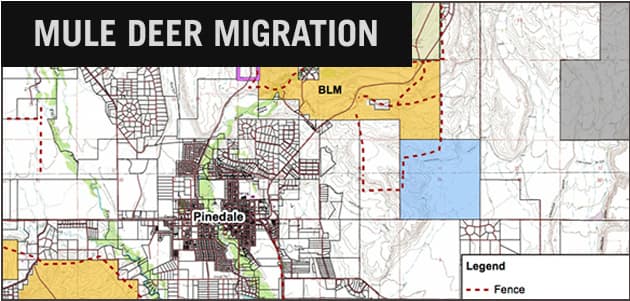
As such, it could have been developed, pinching off a 400-yard wide bottleneck used twice a year by up to 5,000 mule deer. They trek 150 miles from the Red Desert to Hoback Junction in what researchers say is the longest mule deer migration ever documented.

The parcel was the top priority for preservation along the route, said members of the Wyoming Migration Initiative who helped document the deer pathway.
“Those deer cross Pine Creek single file onto this property,” Lynch said. “Seeing it subdivided and developed, it would be a real bummer.
“It’s a rare thing — in my over 15 years doing land conservation work — to have a group of biologists call you and say ‘You’ve got to do something about this property,’” Lynch said Thursday. “This is a key, key link.”
Sublette County property records list the owner as Donald W. Whitaker, trustee, with addresses in Decatur, Arkansas, and Pinedale. Market value of the property as set by the Sublette assessor is $172,225, according to county records.
Most of the acreage is listed as agricultural property and consequently is assessed on its production rather than its value as potential developed property.
The land was listed for sale when the Conservation Fund got involved, Lynch said.
“Their intent was to sell the property,” he said. The land could be served by town water, he told the Wyoming Game and Fish Commission in Pinedale on Thursday, and there was talk about “dividing it really small.”
“If that were to get divided up you’d have a severe block,” he told the commission. The Conservation Fund has three months to complete the purchase.
“This is not going to be an easy task,” he told the commission.
Nevertheless, “We’re thankful that they’re willing sellers and that they’ve given us a chance to buy it,” Lynch said in an interview with WyoFile. “They’re good to work with.”
Should the fund secure the property, it would seek to relocate an elk fence on the north lot line that is an obstacle to the deer, Lynch said. Relocation would make deer migration easier but still retain the function of the fence, designed to keep elk away from private property and cattle.

Lynch did not ask the commission for money. He also said The Conservation Fund would rather not own the land permanently, suggesting it would seek a buyer who would keep the property’s pastures open.
“The ultimate goal is not to even be in the management of that property,” he said.
While Game and Fish has known about Sublette mule deer migrations for years, the link to the Red Desert and the record 150-mile migration distance wasn’t discovered until a project began in 2011, Hall Sawyer with Western Ecosystems Technology, Inc. told the commission. That year researchers collared deer south of Sublette County near Interstate 80 in Sweetwater County.
The record migration route crosses several highways (deer do not venture south across Interstate 80) and “more than 100 different fences,” Sawyer said. Deer make the migration because they have to; they take advantage of greening vegetation along the way north, researchers say.
At any given spot along the route, the bulk of the deer will pass during a two- to three-week window, Sawyer said. In some areas, they stop and linger. Spring migration is slower than the fall return trip, he said.
“They show really strong affinity to these migration routes,” he told the commission. “If you do take conservation action, you know you’ll get bang for your buck every year.”
The Whitaker bottleneck property is surrounded by other obstacles and places where lots of people recreate, including on U.S. Forest Service and BLM land, Sawyer said. Fremont Lake is one obvious obstacle; some deer swim its outlet, which poses perils in spring when there’s thin ice there.
“Drowning is a real risk,” Sawyer and colleagues wrote in “Red Desert to Hoback Mule Deer Migration Assessment.”
Nearby there’s also private land, homes, a marina and multi-use recreation trails at CCC Ponds.
“There’s issues there with the Forest Service, BLM — how are we going to plan this recreational development on these migration routes,” Sawyer said.
A potential benefit could be using the recreational draw of the Fremont Lake area to inform people of the migration and promote conservation, Sawyer said.
As an indication of public interest in mule deer, a video made by photographer Joe Riis and posted online has seen more than 1.5 million views in four months, Sawyer said.