

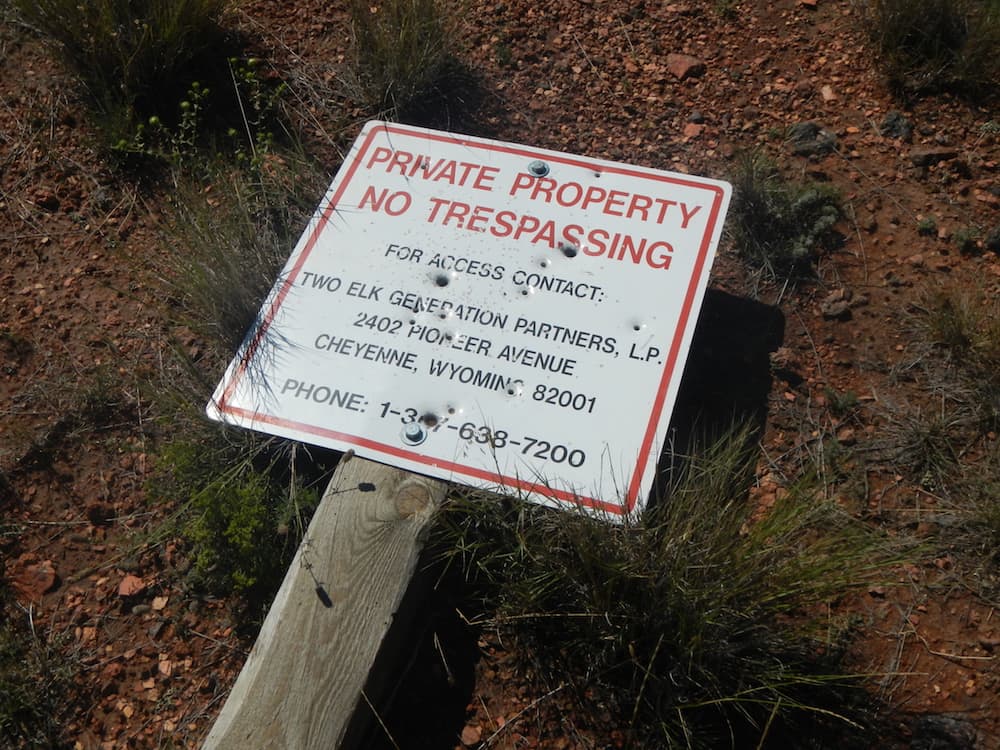
Two Elk developer Michael J. Ruffatto pleaded guilty to criminal fraud Friday in a case federal prosecutors said involved falsely billing millions of dollars to a Department of Energy stimulus project at the Two Elk site near Gillette, monies that Ruffatto secretly diverted to a private account and used to pay for his “extravagant lifestyle.”

“Records show,” Assistant US Attorney Mary McKeen Houghton told the federal court in Pittsburgh, “that millions of dollars of the government’s [stimulus] award monies were never used on the project, but spent and dissipated by the defendant on extravagant personal expenses, totally unrelated to the project, including payments for the defendant’s personal residence in Englewood, Colorado, payments for the defendant’s Mercedes Benz, payments for personal purchases at Neiman Marcus, payments for carpeting worth thousands of dollars, payments for expensive jewelry, and payments for the defendant’s international travel.”
Ruffatto, who faces a maximum penalty of five years in prison, pleaded guilty to only one charge: that on October 13, 2011 he submitted a false bill to the DOE for $363,668.50. One of the federal prosecutors said the U.S.Attorney’s office may also bring a civil case, with a possible multi-million dollar damage claim, against Ruffato and his company.
Assistant US Attorney Houghton told the court that if the criminal case against Ruffatto went to trial, the government would present evidence that the Colorado attorney and power plant developer actually submitted $5.7 million in a dozen false invoices for work that was never done on the stimulus project. The project was ostensibly a scientific study of CO2 storage potential at Ruffatto’s Two Elk Energy Park in Campbell County south of Gillette.
Sentencing was set by Chief U.S. District Judge Joy Flowers Conti for February 3, 2017.
Employee testimony not heard; civil case still possible
Ruffatto’s waiver of his right to a trial by jury ensured that his North American Power Group Vice President Brad Enzi, son of Wyoming US Sen. Mike Enzi, will not have to testify in a criminal trial. Houghton said the government had intended to call employees to testify. Before the DOE abruptly cancelled the Two Elk carbon site characterization project in January 2012, Ruffatto paid himself and Brad Enzi more than $1.2 million in salaries from federal stimulus funds.
Brad Enzi previously told WyoFile that he worked on the research project but was ignorant of how much of his salary was billed to the government during the 2009-2011 period in question.
David Hickton, US attorney for the Western District of Pennsylvania, told WyoFile on Friday that his office may also seek civil damages in the case under the False Claims Act, also known as the Lincoln Law, that dates to the prosecution of war profiteers during the American Civil War.
“This is a very significant case,” Hickton said. “There is a very large fraud here. There remains the possibility of civil damages.” Under the False Claims Act the government could seek triple damages– or more than $17 million from Ruffatto and his company, which is co-owner of four power plants in California.
Accompanied by his attorney Jason D. Schall, a former federal prosecutor, Ruffatto, 70, looked ashen and shaken during his courtroom appearance Friday. He answered all of the judge’s questions in a somber baritone that was sometimes too faint to hear.

Approached by reporters, Ruffatto said he had no comment on the federal case. During the years he dealt with DOE officials looking into his grant, he had described the federal investigation as a minor disagreement in a complicated accounting situation. But in the end, he did not dispute the government’s claim that he had improperly billed $5.7 million. Ruffatto said earlier he planned to repay it all, although not on the government’s schedule. So far, he said through a spokesman, he has paid back $3 million, including $1 million he sent in after he was charged with criminal fraud on August 9.
After his guilty plea, Ruffatto was released on a $25,000 unsecured bond and ordered to surrender his passport. Chief US District Judge Flowers Conti restricted Ruffatto’s travel to his home areas in Colorado, southern California and northern Virginia, where he has family.
Pleading guilty to a federal felony could lead to Ruffatto’s disbarment. Ruffatto is a graduate of the University of South Carolina law school and in 1976 was a junior prosecutor in a celebrated Arizona state criminal fraud case.
The federal case is based on a Wyoming stimulus project for the years 2009-2010. But Ruffatto has a 20-year history of dealings in Wyoming, many of which, like the stimulus grant carbon project, received political and economic support from local, state and federal officials. He has proposed a total of seven new power plants in Wyoming near Gillette, four of which were called Two Elk, none of which was ever built.
Want to revisit the Two Elk Saga? Click here.
He proposed his first Two Elk power plant in 1996. Two successive governors awarded him $445 million from Wyoming’s allocation of tax exempt industrial bonds for that plant. State officials spent more than $11 million in sales and use tax revenues for infrastructure to support the phantom plant.
“It would have died numerous times, but for government support,” Shannon Anderson, acting director of the Powder River Basin Resource Council told a reporter from the energy news service Climate Wire. Stimulus funding, she said, “allowed it to keep going to pay their staff, to have the government affairs positions where they were meeting with people, trying to keep it going.”
