
This photograph of burned trees in the Medicine Bow National Forest was taken on Thanksgiving Day. The Mullen Fire left a mosaic of burns across 176,878 acres. (Karlee Provenza)

Representative-elect Karlee Provenza, her husband and their canine companion took a Thanksgiving Day hike west of Laramie to survey what the Mullen Fire left behind.

Driving and hiking the Medicine Bow Forest around Lake Owen, a popular destination for summer fishermen and RV campers, the trio passed through a mosaic of charcoaled trees, scorched earth and erratic burn patterns.

“In some areas the burn just looks so catastrophic, and then across a dirt road you see a completely different type of burn,” Provenza said. “It was really intriguing to look at what the outcome was and wonder what made that happen.”

In particular, Provenza, a longtime photographer, was struck by a group of trees that had been warped by an unknown force. Some were bent until their tops touched the ground, others snapped mid-trunk. A friend who worked in forestry later told Provenza such patches were likely the result of the high winds that drove the fire. 
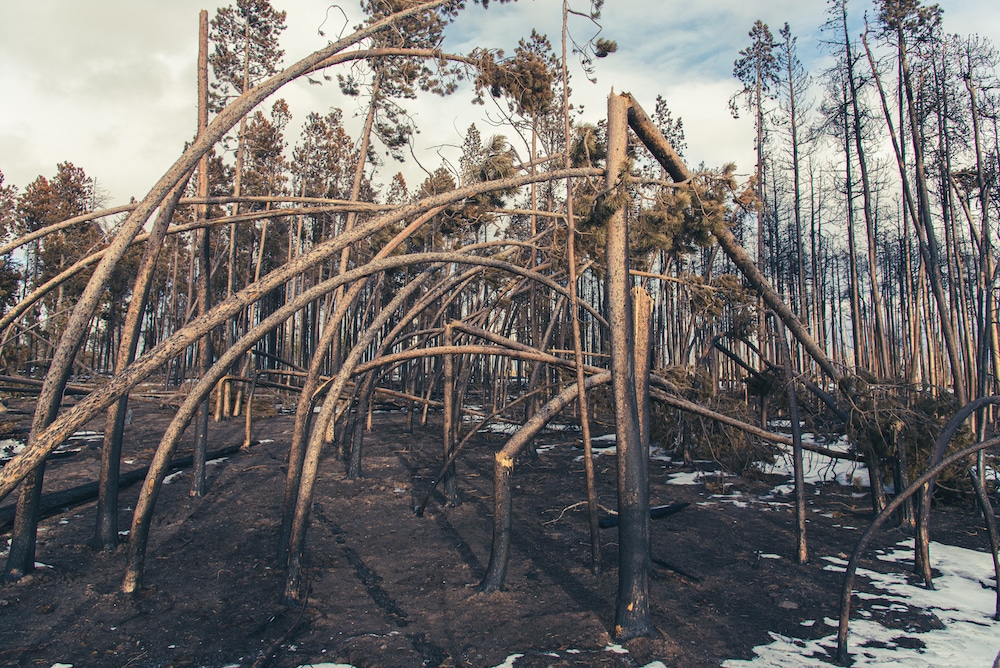
Trees in some areas touched by the Mullen Fire were bent until their tops touched the ground, or trunks snapped, perhaps as a result of fierce winds that drove the fire’s growth. (Karlee Provenza)

Indeed, it was the area’s fierce wind gusts, which firefighters at times clocked as high as 70 miles per hour, that transformed a fire start of unknown origins within the Savage Run Wilderness Area into a 176,878-acre monster that prompted hundreds of evacuations and indelibly altered the character of the Medicine Bow National Forest. 

The Mullen Fire’s intensity varied. Much of the fire area’s eastern half, where Provenza visited, burned more voraciously, according to an Oct. 25 map of soil burn severity posted by the U.S. Forest Service. Burn severity is measured by how much the fire consumes ground cover and organic matter — leaf litter, duff and “fine roots,” according to the USFS map. 

Just observing a stand of burned trees does not necessarily give a good indication of burn severity, USFS spokesperson Aaron Voos told WyoFile. “While the trees may look like blackened toothpicks, that doesn’t mean the soil burn was severe,” he said. Assessment work, as well as rehabilitating and combating an influx of invasive plant species like cheatgrass, will continue in the spring, Voos said. 

“This thing burned so late into the fall and went straight from active fire to snow cover that we haven’t been able to view a lot of the burnt area without snow on it,” he said.

The Mullen Fire was the largest fire on record in the Medicine Bow National Forest. It may also be the largest fire resulting from a single start in Wyoming history, Voos said. Though the famous 1988 fires in Yellowstone National Park burned a larger area — nearly 800,000 acres — that complex of blazes began after a series of lightning strikes. The cause of the Mullen Fire remains under investigation, Voos said, but the fire began from one source. 

As of Oct. 24, fighting the fire had cost $41.2 million, according to a report the U.S. Forest Service posted online. Wyoming is on the hook for around 2% of that, a little more than $800,000, according to Wyoming State Forester Bill Crapser. 

The charred forests Provenza passed through aren’t without life. She saw mule deer, and the tracks of other animals, on her outing. A WyoFile reporter exploring the forest the next day saw a pair of moose among willows that appeared to have been spared by the fire. 

Support independent reporting — donate to WyoFile today.

Andrew Graham covers criminal justice for WyoFile.

Leave a comment

WyoFile's goal is to provide readers with information and ideas that foster constructive conversations about the issues and opportunities our communities face. One small piece of how we do that is by offering a space below each story for readers to share perspectives, experiences and insights. For this to work, we need your help.

What we're looking for: 

  • Your real name — first and last. 
  • Direct responses to the article. Tell us how your experience relates to the story.
  • The truth. Share factual information that adds context to the reporting.
  • Thoughtful answers to questions raised by the reporting or other commenters.
  • Tips that could advance our reporting on the topic.
  • No more than three comments per story, including replies. 

What we block from our comments section, when we see it:

  • Pseudonyms. WyoFile stands behind everything we publish, and we expect commenters to do the same by using their real name.
  • Comments that are not directly relevant to the article. 
  • Demonstrably false claims, what-about-isms, references to debunked lines of rhetoric, professional political talking points or links to sites trafficking in misinformation.
  • Personal attacks, profanity, discriminatory language or threats.
  • Arguments with other commenters.

Other important things to know: 

  • Appearing in WyoFile’s comments section is a privilege, not a right or entitlement. 
  • We’re a small team and our first priority is reporting. Depending on what’s going on, comments may be moderated 24 to 48 hours from when they’re submitted — or even later. If you comment in the evening or on the weekend, please be patient. We’ll get to it when we’re back in the office.
  • We’re not interested in managing squeaky wheels, and even if we wanted to, we don't have time to address every single commenter’s grievance. 
  • Try as we might, we will make mistakes. We’ll fail to catch aliases, mistakenly allow folks to exceed the comment limit and occasionally miss false statements. If that’s going to upset you, it’s probably best to just stick with our journalism and avoid the comments section.
  • We don’t mediate disputes between commenters. If you have concerns about another commenter, please don’t bring them to us.

The bottom line:

If you repeatedly push the boundaries, make unreasonable demands, get caught lying or generally cause trouble, we will stop approving your comments — maybe forever. Such moderation decisions are not negotiable or subject to explanation. If civil and constructive conversation is not your goal, then our comments section is not for you. 

Your email address will not be published. Required fields are marked *