


Wyoming’s Department of Environmental Quality has verified high ozone pollution at monitoring stations in the Upper Green River Basin, unhealthy levels the agency director says approached “the most detrimental category.”
Sublette County residents earlier this year complained of ozone pollution at some of the five DEQ monitoring sites in the basin. Preliminary readings from monitors, information that DEQ provides instantly at its website, showed 10 days during which ozone levels exceeded federal Clean Air Act standards.
DEQ has validated those preliminary readings, an agency spokesman told WyoFile earlier this month. The confirmations include nine days at Boulder and one at Daniel when ozone levels exceeded the federal standard of 70 parts per billion.
Readings are calibrated in rolling eight-hour averages. Federal standards for that measure were strengthened in 2015 from 75 ppb to 70 ppb “to ensure the protection of public health and welfare,” the federal Environmental Protection Agency said.
The highest ozone reading at Boulder registered 105 ppb, a level the state classifies as “unhealthy” and at which “everyone may begin to experience health effects,” the DEQ website reads. Levels of 106 ppb are “very unhealthy.”
DEQ director Todd Parfitt briefed lawmakers last month about the worrisome events.
“We were quickly approaching the most detrimental category for ozone concentration,” he told members of the Joint Minerals, Business and Economic Development Committee at meeting in Gillette in May. “We were looking at taking even more drastic measures than what had been taken.”
Pollution watchdogs believe the 2019 measures, when coupled with the previous years’ readings, would put the Upper Green River Basin back into a federal “non-attainment” category for exceeding Clean Air Act limits over a three-year period.
“It’s above the maximum,” said Elaine Crumpley, a founding member of the Pinedale-based group Citizens United for Responsible Energy Development. “We’re not meeting the Clean Air Act, I suspect.”
Despite the best efforts?
The pollution occurred despite what the state called a “success” last winter with its Ozone Contingency Plan Program. Twenty-five oil and gas companies operating in the area submitted ozone action plans for the winter, according to a summary contained in a letter sent by the DEQ to program participants.
Ozone forms when sunlight reacts with volatile organic compounds emitted by gas field operations, vehicles and similar sources. Ozone contingency plans call for reducing activities and postponing some operations on ozone action days, when the DEQ forecasts a combination of cold weather, snow cover and low temperatures in the basin.

DEQ called for 16 ozone action days in the first three months of 2019 — the winter ozone forecasting season. “On average, 89% of participants with [ozone contingency plans] submitted Event Summaries after each event,” the DEQ letter said. “This program was a continued success due to the support and immense effort put forth to implement emission-reducing efforts on sixteen OADs.”
An average of 20 companies briefed workers before their shifts and minimized the idling of vehicles, the letter said. An average of 19 companies alerted all personnel and staff of the action days and contingency plans, avoided overfilling fuel tanks and tightened fuel tank caps.
The federal Environmental Protection Agency in 2012 classified the area as a “marginal” ozone non-attainment zone after ozone levels violated federal ozone air quality standards of 75 ppb. In response Wyoming put together a program to curb emission of volatile organic compounds, including the Ozone Contingency Plan program and forecasting when the plans should be implemented.
Pollution levels, measured on a rolling three-year basis, had not since exceeded Clean Air Act standards and associated regulations until possibly this year. CURED members believe that Wyoming is again in the “non-attainment” classification.
The group bases that assertion on a formula that averages the fourth-highest reading from the last three years. Those readings are 73 in 2017, 58 in 2018 and 85 in 2019, watchdogs said.
“When you average that, it’s 72 and the maximum is 70,” Crumpley said. DEQ hasn’t said whether it believes the measurements put the state back into the non-attainment category, or what that would mean if the Upper Green River Basin was again so designated.
Part of the complication arises from the strengthening of air-quality standards in 2015 to 70 ppb. It’s debated whether that, or the less-restrictive 75 ppb — when the Upper Green River Basin non-attainment area was mapped and classified — should apply.
“Statistically it’s there,” Crumpley said of a non-attainment measure.
The Wyoming Outdoor Council is also waiting for action. “I’ve not heard DEQ explain how this is going to change the requirements in the area or in a more narrowed area to ensure that the Boulder area gets back into attainment with ozone … to ensure we get below that 70 ppb,” Steff Kessler, program director with the conservation group, told WyoFile.
The lowdown coming
DEQ is scheduled to meet with area residents in Boulder on June 26 to review last winter’s ozone pollution events and answer questions. The meeting is set for 6 p.m. at the Boulder Community Center.
“They’re going to give us the lowdown [as] to what they decided,” Crumpley said.
DEQ spokesman Keith Guille agreed. “Obviously we’ll be answering any concerns the public has,” he said.

Despite the two standards — one from before and one from after 2015 — “we always want to have [ozone pollution levels] under 70,” he said. That’s what we’ve set and that’s what we’ll continue to strive for.
Just because Wyoming exceeded a limit doesn’t mean the EPA will swoop in, take over programs and impose restrictions on activities, Guille said.
“We’re the ones with primacy with air quality and [the] airshed ,” he said. “There’s a process — we’ll work with EPA.”
A lot of states have areas that are in non-attainment status and haven’t lost primacy, also known as home-rule enforcement of federal standards.
“Our state was a leader and has been a leader on air emissions on minor sources,” Guille said. “We have probably the most stringent standards across the country.”
Nevertheless, “this area is a challenge,” he said. “We’ve been able to reduce emissions a lot. Obviously, it’s not done and we have a lot more to do.”
Guille was echoing what Parfitt told lawmakers in Gillette. “This is a high priority for the agency,” he said. Even though the state and industry worked together on the Ozone Contingency Plan Program and other measures, “clearly that was not enough,” Parfitt said.
Pollution from ponds?
There’s one source of volatile organic compounds that has flummoxed DEQ, Guille said — commercial oilfield waste ponds. They store produced water and other fluids that are a byproduct of oil and gas field production.
“There are no [air-quality] permits,” Guille said. “They’re just not regulated in any way,” for those emissions.
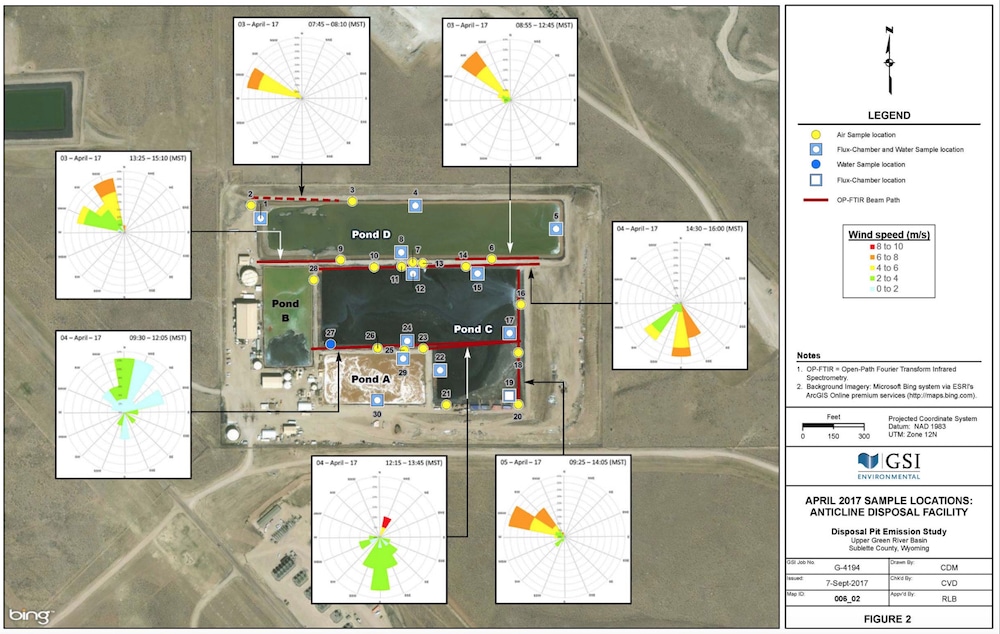
Some basin residents have pointed to a pond near Boulder as a potential source of the volatile organic compounds that are ozone precursors. DEQ’s air quality division, along with a team of contractors, has been working with disposal companies R360 Environmental Solutions, LLC and Anticline Disposal, Inc. to measure air emissions at the LaBarge and Pinedale facilities.
The goal is to develop a tool or model that would allow regulators to determine what volatile organic compounds such ponds emit, Guille said. DEQ would take water samples, plug measurements of their composition into a computer model or program and determine what emissions that water might produce, he said.
“That’s taking some work,” he said. A summary from several years’ study indicates that the model or tool produces poor results.
“Upon conclusion of this study, the tool’s accuracy in predicting emissions remains as much as an order of magnitude in under- or over-predicting individual air emission measurements,” a summary reads. The variations depend on the volatile organic compounds in question, the season and weather.
“Obviously something’s still not right,” Crumpley said. “These are emissions that no one’s catching. That anticline disposal pit needs to be reworked, covered.”
The state has two persons and two forward-looking infrared cameras — essentially leak detectors — to inspect 7,500 wells, she said.
Make a tax deductible donation to Wyoming journalism today.
“That’s crazy,” Crumpley said. “We need more people with better equipment to detect these escaping emissions.”
DEQ’s Guille said the agency is looking to add an additional staff member to police the Upper Green River Basin.
Crumpley doesn’t seek federal intervention, just state action.
“I want them to be able to handle it at the state level with what they are charged to do,” she said. “It’s getting old,” she said of the ongoing pollution. “It’s not a mystery.”

Fossil fuel extraction has to stop; it’s that simple.