

For the first time in decades, Campbell County will not send excess revenue to the state’s School Foundation Program, the primary statewide school fund.
The county’s shift from a “recapture” to an “entitlement” district reveals changing economic dynamics among state communities. It also underscores the risk inherent in Wyoming’s reliance on mineral extraction to provide equitable and adequate funding for each district, no matter its local economic health.
“I think it says a lot about the state of Wyoming,” Wyoming Education Association’s Government Relations Director Tate Mullen said. Some historically mineral-rich counties are generating less revenue for a statewide school funding model that depends on coal, oil and natural gas extraction to serve students across the state.
“It has implications for what the future of Wyoming is going to look like, or at least what should be taken into account when we’re considering the economics of education funding,” Mullen said.
Fossil fuels drive education funding
Wyoming relies primarily on property taxes to fund the bulk — approximately 75% — of school operations. About half of that comes from property taxes assessed on minerals at the county level, according to the Wyoming Department of Education. That means Campbell County, historically flush with coal, oil and natural gas production, has contributed more dollars to statewide school operations than any other county — to the tune of nearly $1 billion since 1984, according to Campbell County School District 1 officials.

But the county took a major hit in 2020. On top of steadily declining coal production, the pandemic temporarily ground oil and gas drilling to a halt and depressed oil prices for most of the year. The toll was recently revealed in the county’s annual assessed valuation, which is down by about $850 million, a decrease of 20% from 2020 to 2021.
Campbell County’s Assessor’s office confirmed that the decline was driven by lower mineral production and prices. School officials in Campbell County say it’s unclear whether the district will return to recapture status beyond the 2021-22 budget year, resuming its long tradition of sharing excess mineral wealth with school districts across the state.
“Typically, Campbell County supports other districts, and that’s not the case this year,” Campbell County School District Fiscal Budget Manager Shelly Haney said.
Balancing revenue and needs
Aside from its heavy reliance on revenues from mineral extraction, Wyoming’s education funding model is designed to meet a series of legal criteria established by the Wyoming Supreme Court. The state must provide equitable and adequate funding for each school district based on a number of factors, the biggest of which is student enrollment from the previous year.
That means no matter how much a particular county or district contributes to the statewide School Foundation Program, it is guaranteed a block grant that represents equitable, student-needs-based funding. Some districts contribute revenues to the statewide funding pool that are less than their block grant “guarantee” while others contribute more, making them either an entitlement or recapture district.
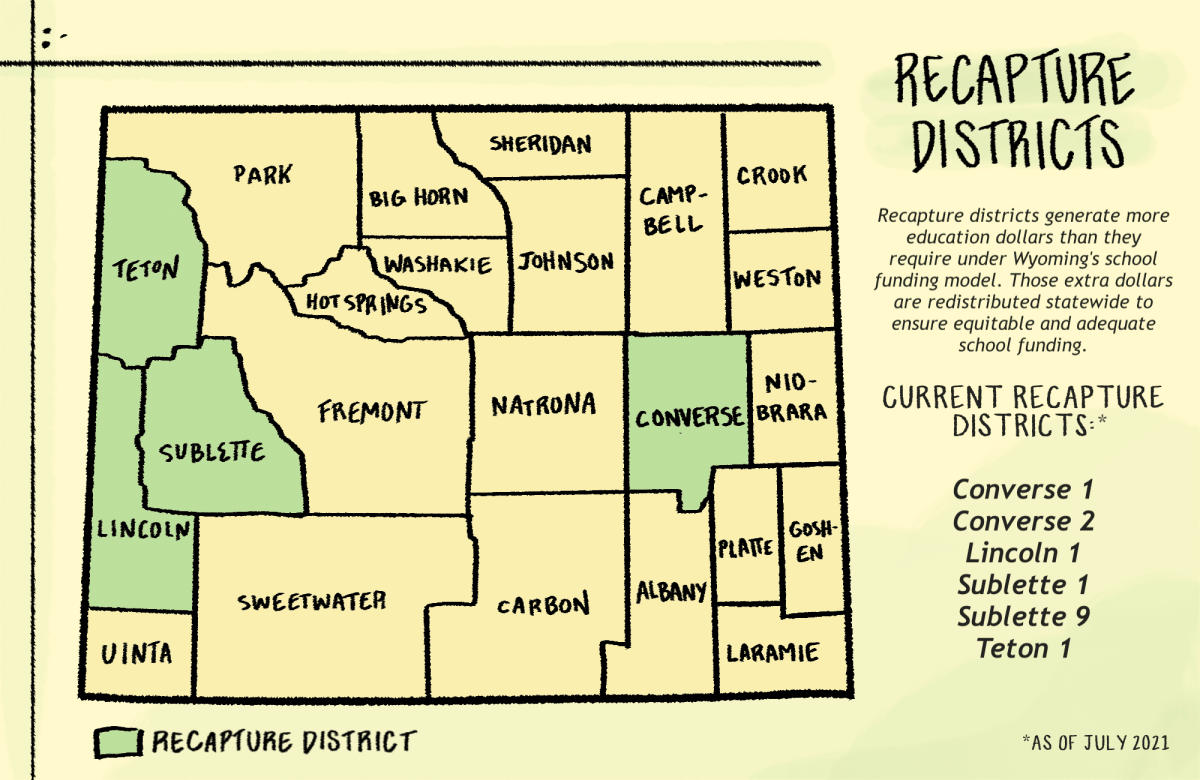
Districts in five counties were categorized as recapture for the 2020-21 budget year: Campbell, Converse, Lincoln, Sublette and Teton. For all but Teton County, which shifted to a recapture district in 2018, mineral extraction accounts for their ability to help balance funding for school operations statewide.
As Campbell County shifts from a recapture to an entitlement district for the 2021-22 budget year, it will be held harmless, still guaranteed its equitable block grant from the School Foundation — about $136 million, according to CCSD 1 officials. Districts in Sublette County, typically in the recapture category due to robust oil and gas development, could also shift to entitlement in coming years, according to the Wyoming Department of Education.

“There are some school districts that flip-flop between recapture and entitlement because of the volatility of energy,” Department of Education Communications Director Linda Finnerty said.
Historically, those local economic ups and downs have demonstrated the strength of the statewide school funding model, officials say.
“It really showcases how our funding system works,” WDE’s Chief Operations Officer Trent Carroll said. “We provide equitable funding across the state to ensure that level of education occurs. We have these triggers in place where the funding can remain constant; when local revenues drop, the state system guarantees that funding will stay at that level. It automatically triggers the state to contribute more, and so we don’t have disparities in education like we did decades ago.”
Shared risk
Today, however, Wyoming’s school funding model also contains a fundamental flaw: If mineral revenue drivers — Campbell, Converse, Sublette and Lincoln counties — all slip into the entitlement category, then the state risks running afoul of meeting the legal requirement of adequate education funding.
Support independent reporting — donate to WyoFile today
The answer is not to change Wyoming’s model of equitable distribution among districts, Wyoming Education Association’s Mullen said. Rather, the state must expand its sources of revenue to fund education.
“We got to start with the tax structure,” Mullen said.
Residents, businesses and prospective businesses alike all value Wyoming’s high quality of education, he said. The question is whether Wyoming, politically, can find its way toward expanding its revenue base. Lawmakers have in recent years stepped past decades-long inertia to at least discuss measures such as an income and corporate tax in response to the prospect of permanent declines in fossil fuel extraction.
“We hope that momentum continues,” Mullen said.
For now, some districts in mineral-dependent communities are seeing declines in student enrollment corresponding to a downturn in energy development. Enrollment at Campbell County School District 1, for example, is down by about 400 students over the past couple of years, Associate Superintendent for Instructional Support Dennis Holmes said. That means the district’s guaranteed block grant from the state will also decrease.
“Our request is just to maintain and sustain adequate funding,” Holmes said. “We just need to have adequate funding.”


This is a HUGE shift. Thanks for the report. In the old days before recapture, when the Campbell County school district needed a new school building, they had so much extra money they just took the funds out of a bank account and built it.: no bonding, no special tax needed. Then, thanks to the Wyoming Supreme Court, recapture spread that wealth statewide. But any year now, there won’t be enough wealth to go around. Will the Legislature deal with this in time?
Dustin Bleizeffer’s article shed even more light on Wyoming’s revenue problem. All of the current triggers that are in place to adequately fund education are doomed to fail. The state’s rainy day account will continue to be tapped for roads, capital construction or any special interest needs deemed necessary by the powers to be.
Mr Mullen hit the nail on the head “We got to start with the tax structure”. My fear is that the road apple tax will be kicked down the dusty road only to be discarded never given the chance to fertilizer the revenue short fall.