

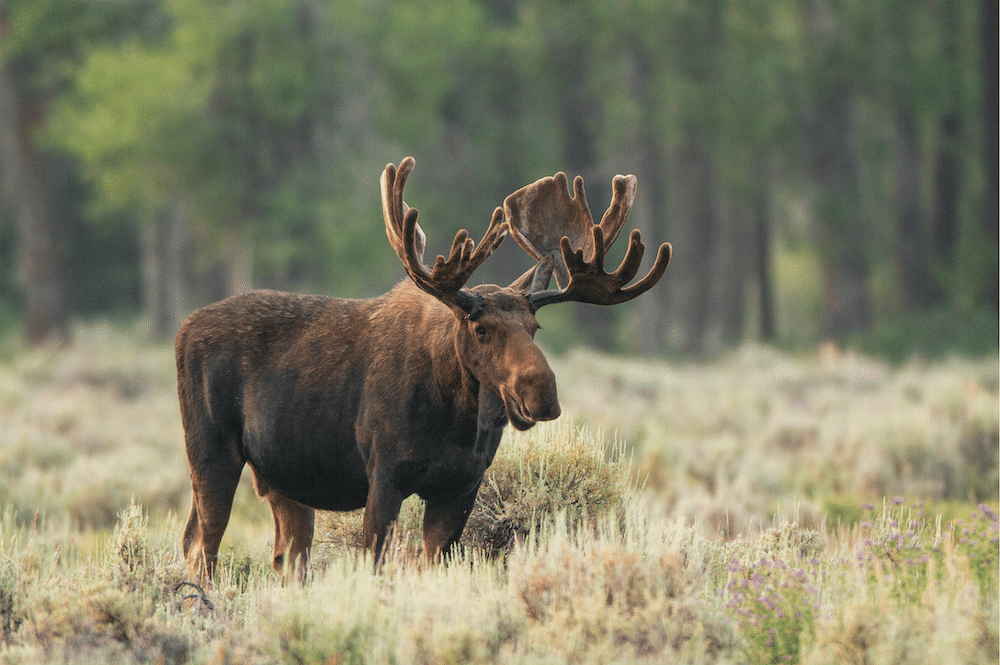
As summer nears its end, bull moose in Wyoming sport impressive antlers covered in dense velvet.
Photographer Timothy Mayo captured this bull in the Gros Ventre River area in Grand Teton National Park on a recent smoky morning. The area, he said, provides the best opportunity for observing the immense bulls — which can weigh more than 800 pounds — this time of year.
Within weeks, he said, bulls like this one will begin shedding the velvet, which shrinks and dries each fall due to fluctuating hormones, by scraping their antlers against branches. That ushers in the rut and mating season, a captivating time to watch the creatures, Mayo said.
Along with being the state’s largest big game animal (wild bison are designated as “wildlife” while grizzly bears fall under “trophy game”), the moose’s lanky frame, palmate antlers and bulbous muzzle make the species a wonder to spot. But as the Wyoming Game and Fish points out, the moose is also the least social ungulate in Wyoming. And it is known to charge at threats like humans.
Wisely, Mayo shoots the animals with a long lens.

There has been considerable discussion about livestock losses to large predators ( black bear, grizzlies, mountain lions, bobcats, wolves and coyotes ) especially since the State of Wyoming/Game and Fish is required to compensate for rancher’s predator losses. However, the livestock losses are only one side of the equation – the other side are the losses of elk, moose, deer, big horn sheep, antelope. It stands to reason that significant livestock losses equate to significant game animal losses also. The livestock losses result in actual monetary losses to Game and Fish and therefore are quantified in the public record. We need to expand the conversation to include game animal losses due to large predators. Our wolf management plan seems to working whereas Idaho and Montana have a dysfunctional wolf management plans. In Wyoming, we need to get the grizzly population under State management in order to minimize losses of game animals and livestock. Game and Fish has already proved they can do it with respect to wolf management – its time for another successful plan – this time for grizzlies. Lets get some factual evidence brought forward about game animal losses due to grizzlies – no more pretending it isn’t happening. Moose are in jeopardy.
All My information came from an important legal case called CROSS v. STATE – it is readily available on the internet via a Goggle search. The legal brief has a detailed analysis of the number of animals wintering on the Cross ranch. Please, please read the legal filing it is historically interesting as far as large ungulates are concerned on the duNoir. The moose population was quite impressive back then. I love our moose ( from a distance of course ). Lee.
“the moose is also the least social ungulate in Wyoming. And it is known to charge at threats like humans. ”
Assuming what Lee C. says in his comment about wintering moose is correct, it would seem that they are very social during the winter if they can actually find other moose. They can certainly be seen in goups in GTNP. Being social isn’t always about the quantity socializing. Perhaps there are just fewer moose, and the observation is about quantity, not social desires.
As for charging humans, even birds do that. And, like birds, moose can pass right by you 5 feet away without a care in the world. Or, bed down in a busy parking lot when open land with native brush is just 100 ft away. Moose may or may not see humans as threats. Just depends. Personally, I always see the moose as a threat but perhaps the moose and I just haven’t had a chance to socialize.
MAJESTIC. Unfortunately, most of our moose have fallen victim to large predators – we’re getting close to the point of petitioning for listing them as T&E due to predators. The large herd in the du Noirs is largely gone and we have lost most of our moose on the Absaroka front. It would be really nice if someone did a comprehensive article on the current Wyoming moose population – especially the moose outside of the national parks. Recently read an article ( court case ) from the 1930s concerning a rancher who had 150-175 moose wintering on him on the du Noirs outside of DuBois – now that’s a healthy moose population. And that’s just one ranch. I’m also concerned the large predators will decimate the big horn sheep herd in the Shoshone National Forest – at 85%, it has more wilderness than any other national forest in the US and functions as an extension of Yellowstone but with very few roads ( North Fork to East gate and Togotowee pass ). Its time to address the affect of large predators on the ungulates.
They seemed to do fine coexisting with the predators for a long, long time, right up to when we human monkeys came along with our dominionist, resource-plundering ways.