
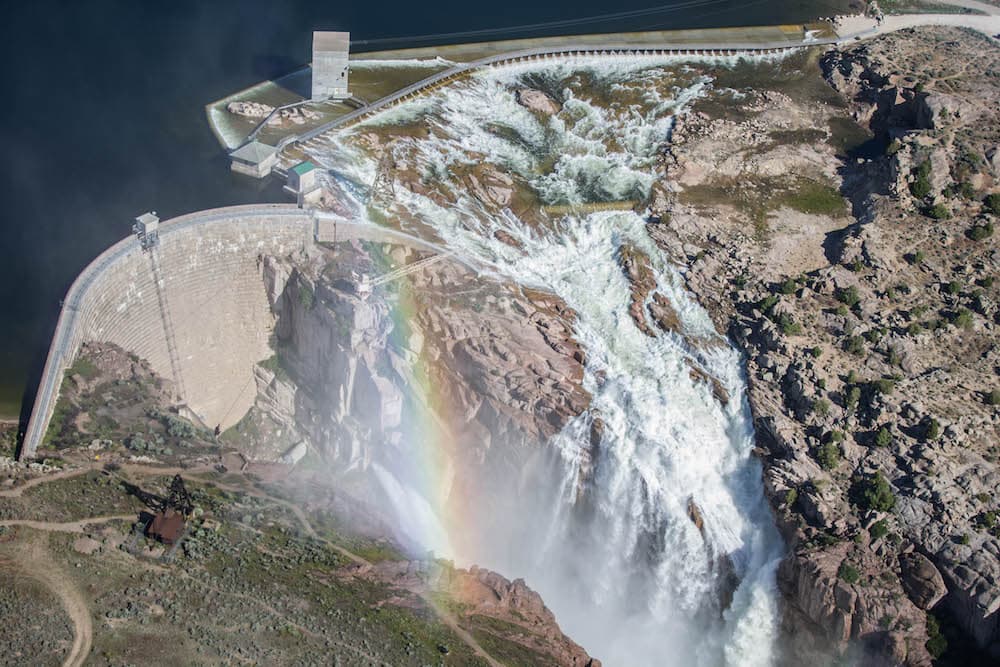
The uncontrolled spillway of the Pathfinder Dam in central Wyoming saw use in June 2016. If operators don’t empty enough reservoir space before peak runoff arrives, Mother Nature decides what the flows will be below the dam. That can spell disaster for downstream communities. If they clear too much space though, the reservoir may not refill, an outcome with its own serious consequences. (Bureau of Reclamation)

Wyoming currently boasts a better than average snowpack —  108 percent of the typical water content for this time of year, according to the first measurement of spring by the Natural Resource Conservation Service.

The NRCS measures the water content from a network of high-tech mountain stations that can be remotely read by analysts. The SNOTEL stations give observers information to calculate the water content in 19 drainages across the state.

Wyoming’s snow-water map shows the amount of runoff expected in various river basins (Natural Resources Conservation Service)

Readings published Monday show the highest reading — 126 percent of median water content — in the Little Snake River drainage south of Rawlins. The Tongue River drainage holds the lowest reading at 84 percent.

Although winter, 2018-’19 might have seemed brutal, the snowpack this spring doesn’t measure up to that of the last two years, according to the service. At this time last year “the state was at 113 percent, and at 132 percent in 2017,” Ken Von Buettner, an analyst with NRCS Snow Survey in Casper, wrote in his 16th report of the snow season.

He calculates the percentages by comparing current readings with a reference period spanning 1981-2010.

Other federal and state weather and river-flow prediction services can help residents prepare for the runoff. The National Oceanographic and Atmospheric Administration’s 2019 spring flood outlook of March 21 identified major flooding in the Midwest but said it’s too early to predict what might happen in Wyoming.

Residents can check the National Weather Service’s interactive website to see whether flood risks are rising and whether or when they are expected to reach various flood stages.
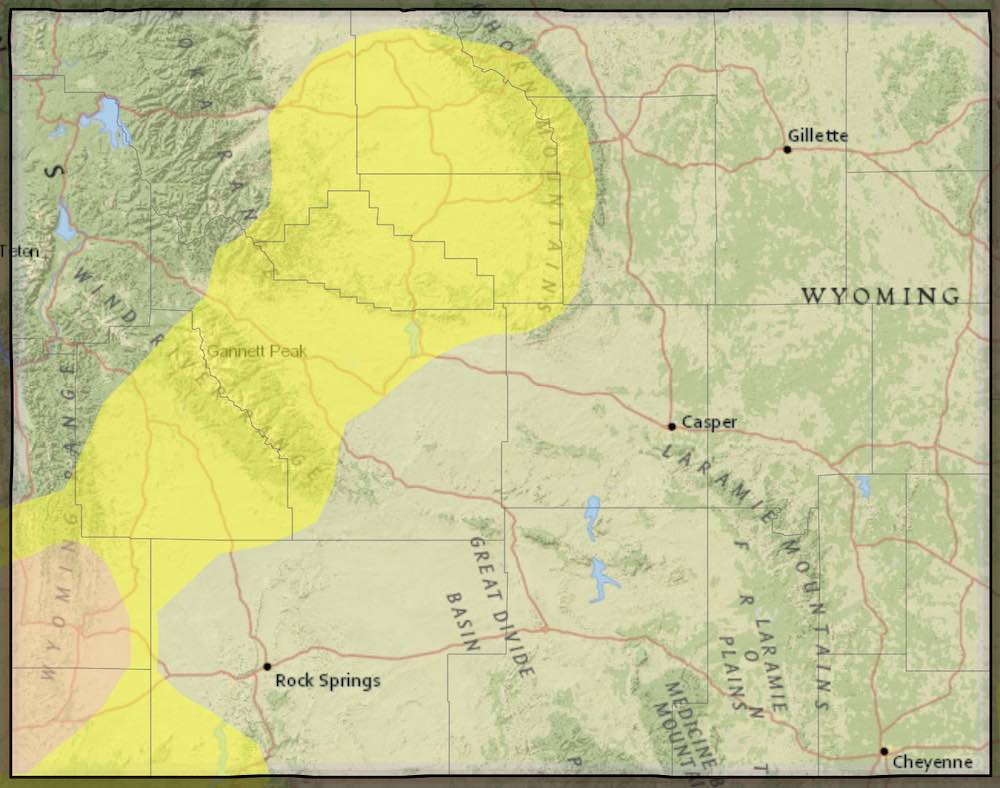
The current map of drought in Wyoming shows abnormally dry conditions in light yellow and moderate drought in brown. (National Integrated Drought Information System)

State drought monitors map a swath of “abnormally dry” conditions from the Bighorn Basin to the southwestern corner of the state and an area of  “moderate” drought in the far southwest. Irrigators can check the Wyoming water supply outlook and map, which is updated regularly.

Support natural resources reporting with a tax-deductible donation

Those interested in walking on earth, not snow, in the high country can check out another interactive map by ESRI that predicts when the snowpack will melt out at various locations.

Teacup diagrams that show how much water various federal reservoirs are holding are available for areas west of the Continental Divide.

Angus M. Thuermer Jr. is the natural resources reporter for WyoFile. He is a veteran Wyoming reporter and editor with more than 35 years experience in Wyoming. Contact him at angus@wyofile.com or (307)...

Leave a comment

WyoFile's goal is to provide readers with information and ideas that foster constructive conversations about the issues and opportunities our communities face. One small piece of how we do that is by offering a space below each story for readers to share perspectives, experiences and insights. For this to work, we need your help.

What we're looking for: 

  • Your real name — first and last. 
  • Direct responses to the article. Tell us how your experience relates to the story.
  • The truth. Share factual information that adds context to the reporting.
  • Thoughtful answers to questions raised by the reporting or other commenters.
  • Tips that could advance our reporting on the topic.
  • No more than three comments per story, including replies. 

What we block from our comments section, when we see it:

  • Pseudonyms. WyoFile stands behind everything we publish, and we expect commenters to do the same by using their real name.
  • Comments that are not directly relevant to the article. 
  • Demonstrably false claims, what-about-isms, references to debunked lines of rhetoric, professional political talking points or links to sites trafficking in misinformation.
  • Personal attacks, profanity, discriminatory language or threats.
  • Arguments with other commenters.

Other important things to know: 

  • Appearing in WyoFile’s comments section is a privilege, not a right or entitlement. 
  • We’re a small team and our first priority is reporting. Depending on what’s going on, comments may be moderated 24 to 48 hours from when they’re submitted — or even later. If you comment in the evening or on the weekend, please be patient. We’ll get to it when we’re back in the office.
  • We’re not interested in managing squeaky wheels, and even if we wanted to, we don't have time to address every single commenter’s grievance. 
  • Try as we might, we will make mistakes. We’ll fail to catch aliases, mistakenly allow folks to exceed the comment limit and occasionally miss false statements. If that’s going to upset you, it’s probably best to just stick with our journalism and avoid the comments section.
  • We don’t mediate disputes between commenters. If you have concerns about another commenter, please don’t bring them to us.

The bottom line:

If you repeatedly push the boundaries, make unreasonable demands, get caught lying or generally cause trouble, we will stop approving your comments — maybe forever. Such moderation decisions are not negotiable or subject to explanation. If civil and constructive conversation is not your goal, then our comments section is not for you. 

Your email address will not be published. Required fields are marked *