

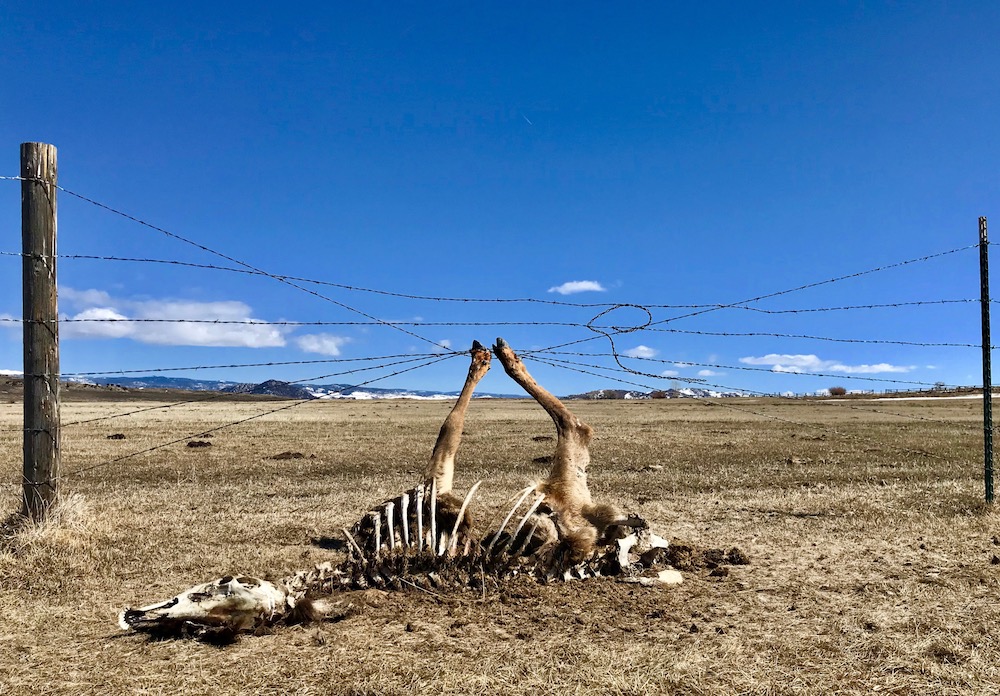
Early spring in the North Platte River Valley reveals the body of an elk calf with legs entangled in a wire fence meant to keep cattle in but which proved deadly to this ungulate. (Andrew Graham/WyoFile)
Share this:

As the snowpack recedes in Wyoming, it reveals the dead.

Wildlife can die from a number of causes in winter, from starvation to cold. This photograph of what appears to be an elk calf carcass in the North Platte River Valley captured a man-made mortal threat to wildlife — entanglement in a wire fence meant to control cattle.

Data on how many wild ungulates die when attempting to cross Wyoming fences is difficult to find. A 2006 study from the University of Utah looked at wildlife mortality along 600 miles of fence in Utah and Colorado. Researchers estimated one ungulate gets caught each year for every 2.5 miles of fence.

Mortality rates are increased to one ungulate death for every 1.2 miles of fence by the indirect deaths of fawns found dead next to fences but not entangled. The dead young were likely separated from their mothers when they could not cross the fence, according to researchers.  

The majority of ungulates become tangled in the top wires while trying to jump the fence. That may be what happened to this badly tangled animal, but its legs are wrapped into both the top and bottom strands of wire.

A 2015 guide from the Wyoming Wildlife Foundation offers advice to ranchers who want to build more wildlife-friendly fences.
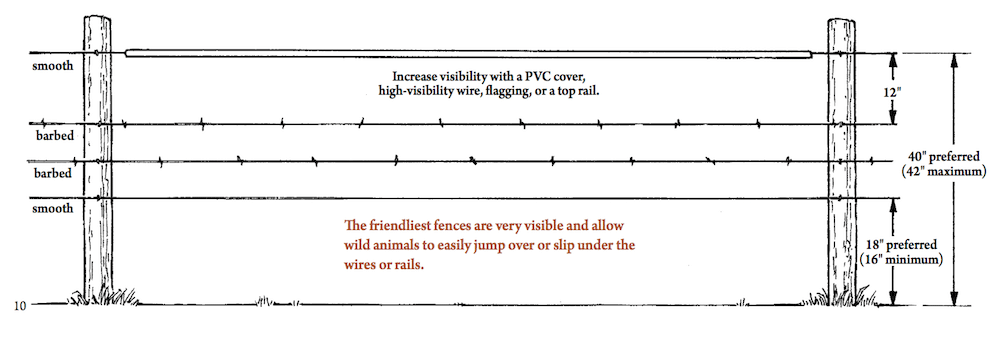
A diagram of how to build an ungulate-friendly fence, from a 2015 handbook for landowners by the Wyoming Wildlife Foundation.

Andrew Graham covers criminal justice for WyoFile.

Join the Conversation

3 Comments

WyoFile's goal is to provide readers with information and ideas that foster constructive conversations about the issues and opportunities our communities face. One small piece of how we do that is by offering a space below each story for readers to share perspectives, experiences and insights. For this to work, we need your help.

What we're looking for: 

  • Your real name — first and last. 
  • Direct responses to the article. Tell us how your experience relates to the story.
  • The truth. Share factual information that adds context to the reporting.
  • Thoughtful answers to questions raised by the reporting or other commenters.
  • Tips that could advance our reporting on the topic.
  • No more than three comments per story, including replies. 

What we block from our comments section, when we see it:

  • Pseudonyms. WyoFile stands behind everything we publish, and we expect commenters to do the same by using their real name.
  • Comments that are not directly relevant to the article. 
  • Demonstrably false claims, what-about-isms, references to debunked lines of rhetoric, professional political talking points or links to sites trafficking in misinformation.
  • Personal attacks, profanity, discriminatory language or threats.
  • Arguments with other commenters.

Other important things to know: 

  • Appearing in WyoFile’s comments section is a privilege, not a right or entitlement. 
  • We’re a small team and our first priority is reporting. Depending on what’s going on, comments may be moderated 24 to 48 hours from when they’re submitted — or even later. If you comment in the evening or on the weekend, please be patient. We’ll get to it when we’re back in the office.
  • We’re not interested in managing squeaky wheels, and even if we wanted to, we don't have time to address every single commenter’s grievance. 
  • Try as we might, we will make mistakes. We’ll fail to catch aliases, mistakenly allow folks to exceed the comment limit and occasionally miss false statements. If that’s going to upset you, it’s probably best to just stick with our journalism and avoid the comments section.
  • We don’t mediate disputes between commenters. If you have concerns about another commenter, please don’t bring them to us.

The bottom line:

If you repeatedly push the boundaries, make unreasonable demands, get caught lying or generally cause trouble, we will stop approving your comments — maybe forever. Such moderation decisions are not negotiable or subject to explanation. If civil and constructive conversation is not your goal, then our comments section is not for you. 

Your email address will not be published. Required fields are marked *

  1. This reminds me of why it’s too bad that our state legislature works to undo counties’ attempts to require wildlife-friendly fencing. How controversial can that be, especially here in Teton Co where the word is out on the multiple ways we can have effective fences that also work for wildlife? Scenes like this are heartbreaking and unnecessary.

  2. Wire barrier fencing, as Woven Wire, dual stranded Barbed and Barbless, smooth single strand High Tensile, and all types of DC Electrified cordage and wires, will continue to be problematic as Human installed barriers to either contain or forbid trespass to Livestock, Wildlife (on legs or Wing) and Humans! What is imperative is to try and mitigate some of the impact and entanglement dire issues this “ENTANGLED” news by WyoFile shows. VISIBILITY of a wire barrier, to be detected at a great distance, is imperative to notify detection of all wire or cordage barriers to avoid contact. MOTION detection that is coupled directly with VISIBILITY is addressed at my published research blog at http://WWW.FENCEFLAGWOLFTRAINING.COM. In short, cost effectiveness and labor to install and maintain barrier fences, continues to be a deciding factor, as there is no perfect solution to 100% solve barrier fence dire consequence issues. “Murphy’s Law’ is forever present with barrier fencing!! DJK

  3. All fences on Wyoming State Land and federally managed public lands should be mandated to meet the wildlife friendly fence recommendations suggested by the Wyoming Wildlife Foundation.