

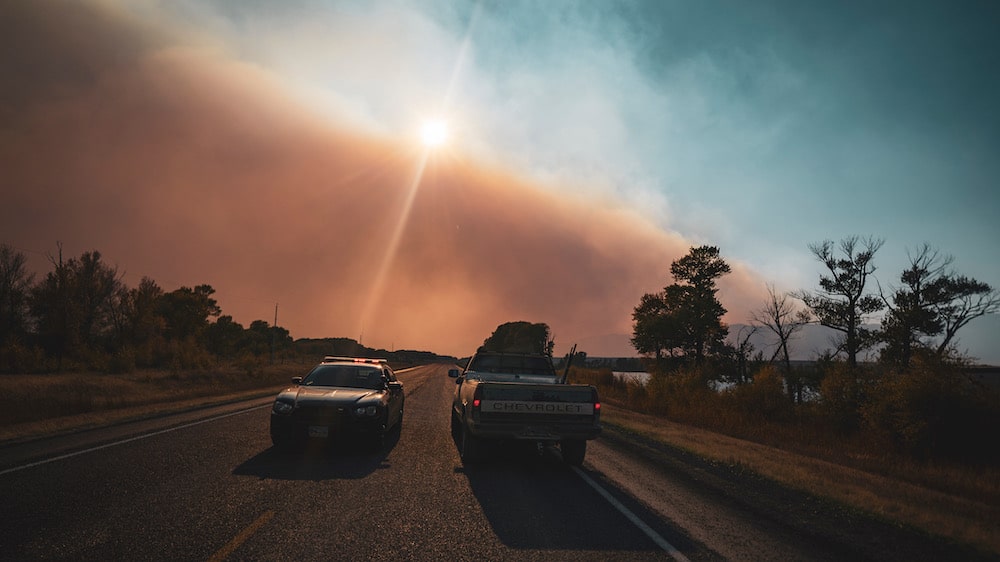
For weeks last summer, southeast Wyoming residents woke each morning to smoke. Sometimes it was so thick it burned people’s eyes and lungs. Other times it felt like a strange haze, a gauze wrapped around the Laramie and Cheyenne valleys.
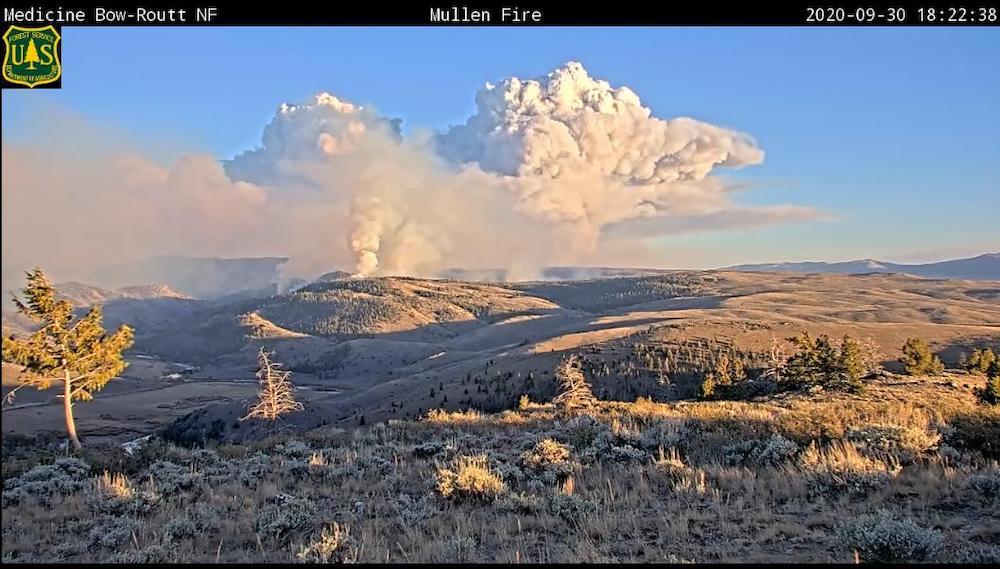
The Mullen Fire ultimately burned more than 176,000 acres in the Snowy Range, making it one of the largest, if not the largest, wildfire in the state in the past century. Over the border in Colorado, a series of fires — some historic — raged for months, consuming scores of buildings and hundreds of thousands of acres of carbon-absorbing trees. One complex of fires in northern California, meanwhile, burned an area larger than Rhode Island. Smoke from these fires and others poured into communities across America, blotting out the sun and serving as a reminder of the blazes.
While most people pay attention to the impact of air quality on human health, or the damage caused by the actual fire, a team of University of Wyoming researchers has been studying how wildfire smoke affects climate change.
The soundbite is that wildfire smoke may be cooling the atmosphere slightly more than previously thought.
But as with all research, the soundbite is much more nuanced than it, well, sounds.
“We were essentially looking at the brightness of the smoke, so how much light was being scattered by the smoke,” said former UW doctoral student Hunter Brown. “The smoke tended to be quite bright in observations, which indicates a cooling effect because it’s reflecting light back to space.”
Brown co-authored “Biomass burning aerosols in most climate models are too absorbing,” with UW atmospheric science professor Shane Murphy and their work was published recently in the journal Nature Communications.
In the paper, Brown analyzed a dozen data sets with hundreds of points from fires around the world to help give researchers a better understanding of how light interacts with carbon particles in wildfire smoke.
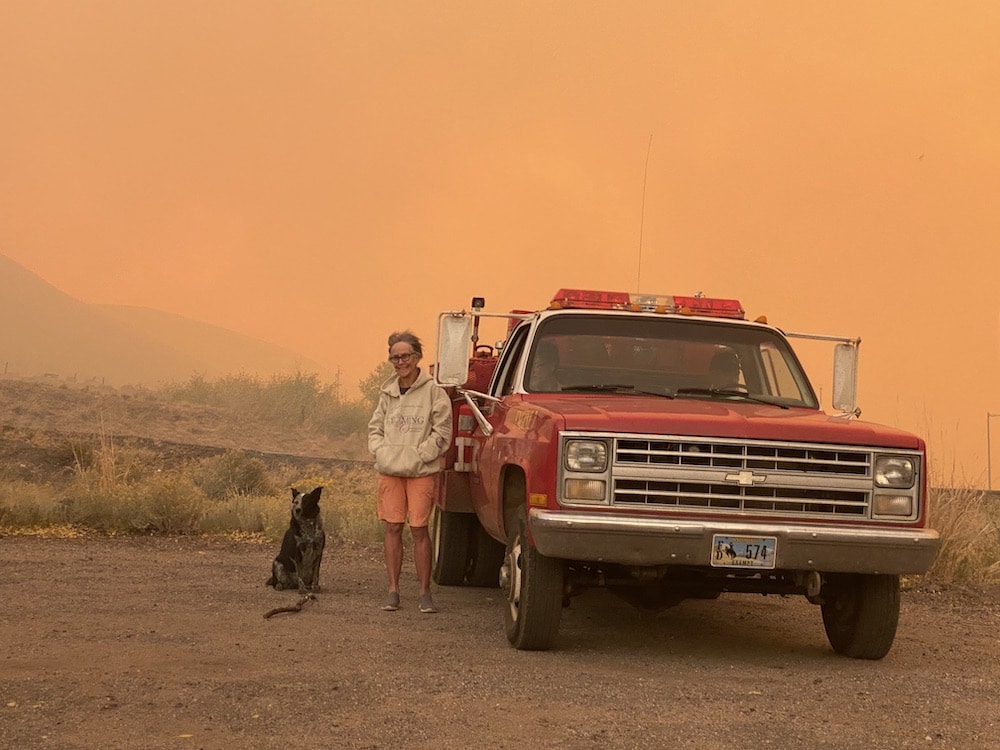
“And then models are used to predict what our future will be like,” said Bob Yokelson, an atmospheric chemistry and climate professor with the University of Montana who was not involved in the study. The hope, Yokelson said, is that studies like these can ultimately help humans prepare for a changing climate.
“Imagine in a video game… when you’re playing it and all these attacks come from nowhere… You’re basically constantly reacting to a threat,” he said. “It’s a metaphor for the future. Do we want to be constantly reacting to the threat before we get killed? The model allows us to have some kind of coherent planning process.”
Where there’s smoke
We can all see and feel the effects of a changing climate on our planet. Places like Texas and Tennessee were hobbled by a deep freeze recently while Antarctica recorded temperatures in the mid-60s. Drought grips the West and Southwest, while Central America struggles to recover from devastating hurricanes. January 2021 was the fifth warmest January in 126 years.
Researchers have long suspected that wildfire smoke alone wasn’t likely causing climate change to worsen. If that was the case, wildfires would have created a feedback loop that would have removed forests millions of years before fire suppression, Yokelson said.
But fires have many components, from the quality of particles to gasses to the severity of how they burn. That’s why models — as boring as they sound — help us understand what to expect in the future.
Simulated experiments show scientists what will happen with certain increases in heat-trapping gasses, for example. Researchers can then tweak individual factors like methane or CO2.
“With models you can say, ‘what happens if we switch our vehicles to electric, what if we do this policy change or that’ and predict if you have a good outcome or bad,” Yokelson said. “Models are a tool for evaluating human action.”
But models can always be improved and tweaked for even greater accuracy, which is what Brown and Murphy set out to do.
When it comes to climate and fire research, Murphy is the one who flies in planes through blackened smoke to measure particles, and Brown is the one who takes those measurements from Murphy and researchers around the world and inputs them into computerized models.
In doing just that, what Brown found is that the models gave slightly too much weight to the possibility of smoke particles warming the planet. In real life, the carbon particles were reflecting more light than models had shown. A clear understanding of the complicated interplay between smoke and light, he said, is only growing more paramount.
“As we go forward in time, we can observe there’s more wildfires now than there were,” Murphy said. “So it’s becoming more and more important that we get smoke emissions right because this is becoming a bigger and bigger effect.”
One piece of the puzzle
Even with greater knowledge about the wildfire smoke paradigm, the role fires play in climate change is incredibly complex.
Wildfires can alter clouds and storms, for example.
A major wildfire can sometimes form really thick clouds, but those clouds won’t produce rain because of the quantity of aerosols inside them. Other times fires can lead to intense thunderstorms.
Fires also emit massive amounts of CO2 into the atmosphere, contributing to warming. But vegetation grows back in their place, sometimes offsetting that CO2 release.
Smoke is just one piece of that larger climate and fire puzzle, Brown, Murphy and Yokelson say.
Support independent reporting — donate to WyoFile today
The question moving forward, however, is this: As the planet continues to warm, creating droughts and adding to fire hazards, will it create a cycle of fires causing more warming, thus causing more fires?
Experts don’t yet know. But they do know the models they use and continue to hone through information like Murphy’s and calculations like Brown’s will be critical in helping us peer into our planet’s future.

Christine Peterson is a world-class journalist with a gift for translating complex scone into great stories.
This article does seem to downplay the environmental devastation caused by these fires. Too bad the people who see themselves as protecting the environment don’t stop interfering with forest management. This fire was predicted in advance. The Forest Service has continually been harassed by lawsuits stopping logging and removal of fuels. By the same people who decry carbon emissions. Well now we have 176,000 acres of black sticks with God knows how much Co2 released into the atmosphere.
The Forest Service has always been a tool of the logging industry. Kind of like Wildlife Services serves livestock farmers, with the rest of us footing the bills.
Whenever I read an article downplaying–even subtly–climate change, I cannot but wonder who funded the studies… The petroleum peddlers were aware of its reality and likely effects back in the 1970s.
Yup, Harvey, again, you nailed it. Thanks!